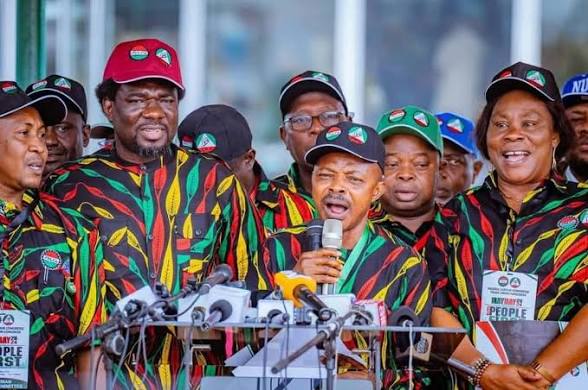
Hundreds of aggrieved workers of the Federal Capital Territory Administration (FCTA), backed by the Nigeria Labour Congress (NLC), on Monday staged a dramatic demonstration at the National Industrial Court in Abuja, intensifying an ongoing total and indefinite strike that has paralysed key government services in the federal capital.
The workers, organized under the Joint Unions Action Committee (JUAC), converged at the court premises, picketing with bold placards emblazoned with demands such as “Wike must go!!”, “Abuja no be Rivers”, “Pay promotion arrears”, “Enough is Enough” and “No working tools”, reflecting deep frustration with the leadership of the FCTA and its political head, the Minister of the Federal Capital Territory, Nyesom Wike.
The demonstration followed a directive from the NLC, which has thrown its full weight behind the industrial action, describing the strike as “justified” in light of what labour leaders call persistent violations of workers’ rights and a failure by the FCTA management to fully address longstanding labour grievances.
The protest comes amid an indefinite strike that has effectively shut down many government offices in Abuja, as workers press for the full implementation of improved conditions of service, payment of owed arrears, and respect for labour rights. According to union leadership, the FCTA has failed to meet crucial welfare demands, including unpaid wage awards and promotion entitlements, issues that have festered despite repeated negotiations.
Labour sources say the strike was triggered after a seven-day ultimatum issued to the FCTA expired without satisfactory resolution. The unions have argued that core issues, including implementation of statutory provisions and welfare enhancements, remain unfulfilled.
At the centre of Monday’s action was a planned hearing at the National Industrial Court. The FCT Minister, Nyesom Wike, and the FCTA had earlier approached the court to challenge the legality of the strike and to obtain orders restraining the unions from continuing picketing, blocking access to offices, and disrupting administrative duties. The suit, filed under NICN/ABJ/17/2026, names JUAC leaders as defendants and was scheduled for hearing on January 26, presided over by Justice Emmanuel Danjuma Subilim.
The unions responded to the legal move by mobilising workers for a solidarity march to the court, emphasizing that the protest would remain peaceful and lawful. In a mobilisation notice, the unions called on workers across all departments, agencies and secretariats of the FCTA to turn out “en masse” to show unity and support for their collective cause, stressing compliance with Nigeria’s labour laws and constitutional rights.
Beyond court proceedings, the NLC has repeatedly accused the FCTA leadership of disregard for basic labour standards, including alleged intimidation of workers and failure to remit statutory contributions. The Congress has framed the dispute not simply as a local labour disagreement but “the struggle of every worker in the FCT”, calling for unity among workers and support from civil society stakeholders.
Despite statements from the FCTA that some of the workers’ demands have been met, with 10 out of 14 issues reportedly addressed, unions have remained steadfast in their position that unresolved demands still justify continued strike action.
As the protest unfolded, many key public services and administrative functions across Abuja remained suspended, mirroring the broader paralysis caused by the indefinite strike. The presence of workers at the Industrial Court on Monday was intended both to support their legal defence and to maintain pressure on the FCTA leadership.
Union leaders have reiterated that their demands will not be dropped until there is a fundamental change in the way workers are treated within the Federal Capital Territory’s civil service, and until the issues raised through the strike and at court are satisfactorily resolved.