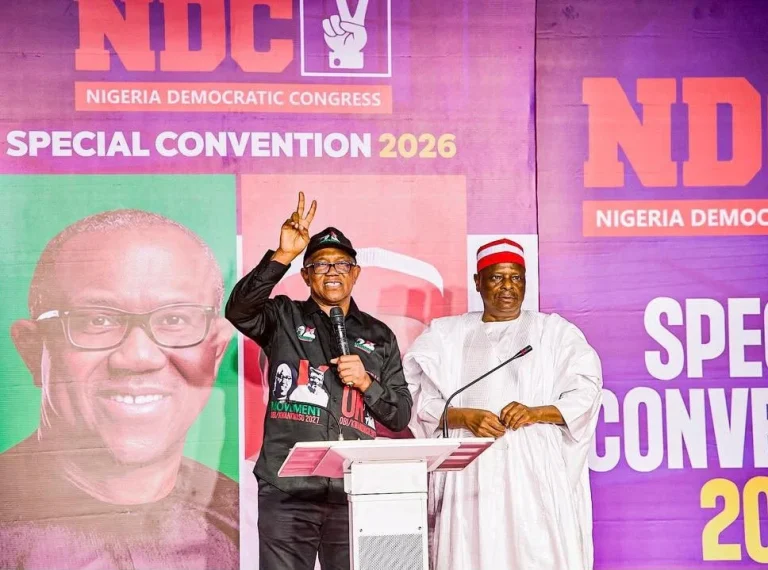
As Nigeria approaches the 2027 general elections, growing anxiety grips political observers and citizens alike amid a wave of defections from opposition parties to the ruling All Progressives Congress (APC) — sparking fears that Africa’s largest democracy may be edging toward a one-party state.
In recent weeks, Governors Peter Mbah (Enugu) and Douye Diri (Bayelsa) both dumped the Peoples Democratic Party (PDP) for the APC, boosting the ruling party’s control to 25 out of 36 states. The PDP now holds 8 states, while the Labour Party (LP), All Progressives Grand Alliance (APGA) and New Nigeria People’s Party (NNPP) each retain just one.
This development, analysts say, signals a systematic collapse of the opposition, reminiscent of the Abacha era, when Nigeria’s political space was dominated by state-controlled parties loyal to the military ruler.
A History Repeating Itself?
Many Nigerians see today’s political realignments as a disturbing echo of the 1996–1998 Abacha years, when five “civilian” parties — the UNCP, CNC, GDM, DPN, and NCPN — all adopted General Sani Abacha as their consensus presidential candidate.
Political historians warn that the current concentration of power around President Bola Ahmed Tinubu and the APC could undermine Nigeria’s multiparty democracy, eroding checks and balances.
PDP Battles Collapse, Opposition in Crisis
Once the dominant force in Nigerian politics, the PDP now faces deep internal divisions, court battles, and mass defections that have crippled its national structure.
Since Tinubu assumed office in May 2023, the PDP has lost over 15 senators, several House of Representatives members, and four governors to the APC.
Other opposition parties are also in disarray:
The Labour Party is fragmented by leadership disputes and multiple factions.
APGA appears ideologically weakened, with its only governor, Prof. Charles Soludo, openly endorsing Tinubu’s re-election bid.
The NNPP faces internal wrangling, with its relevance waning amid leadership struggles.
In an interview, NNPP National Chairman Agbo Major accused the APC of attempting to “kill opposition voices” in Nigeria.
“We are gradually moving toward a one-party state. Without strong opposition, those in power have no one to hold them accountable,” he warned.
He added that the monetary allure of political office in Nigeria fuels the culture of defections and opportunism:
“People no longer build parties from scratch. Everyone wants to join the ruling party because that’s where power and privileges lie.”
Similarly, Senate Minority Leader Abba Moro cautioned during plenary that the ongoing defections are “unhealthy for democracy”, urging Senate President Godswill Akpabio to safeguard the independence of democratic institutions.
APC Defends Defections: “It’s Political Survival, Not a Plot”
Some APC insiders dismiss fears of authoritarianism, arguing that politicians are merely seeking relevance ahead of 2027.
Okpokwu Ogenyi, a Benue APC chieftain, said most defectors are driven by “self-interest, not ideology.”
“Nigeria cannot become a one-party state again. Some join because they believe in the President’s vision, others for survival,” he said.
Ogenyi also cautioned that mass defections could destabilize even the ruling party, urging members to remain committed to ideology rather than convenience.
“PDP Is Reaping What It Sowed” – APC Supporters
Some APC loyalists believe the PDP is now facing the same political tactics it once used.
Dada Akinfemi, a former APC House of Reps aspirant, told The Legal Observer that:
“When the PDP controlled 21 states under Obasanjo, they boasted of ruling for 100 years. They crippled opposition then, and today, they’re getting a taste of their own medicine.”
Rising Alarm from Civil Society and Religious Leaders
However, legal experts and democracy advocates say the trend threatens Nigeria’s democratic future.
Barrister David Mike, a human rights lawyer, described Akpabio’s recent claim that “Tinubu will win 99.9% of votes in 2027” as “undemocratic and dangerous.”
“Such statements from the head of the legislature undermine the spirit of free competition. A true democracy thrives on accountability, not blind loyalty,” he said.
Similarly, Catholic Bishops of Nigeria, in a communiqué signed by Archbishop Lucius Ugorji and Bishop Donatus Ogun, warned that Nigeria is “gradually sliding into a one-party state, which is unhealthy for democracy.”
Echoes from the Past
The fear of political monopoly recalls the Babangida era, when the Social Democratic Party (SDP) and National Republican Convention (NRC) were the only legal parties. That experiment ended with the annulment of the June 12, 1993 election, widely regarded as Nigeria’s freest vote.
Today, as defections mount and opposition voices fade, many Nigerians worry that the balance of power that once defined the Second Republic (1979–1983) — when multiple strong parties ensured accountability — is fast disappearing.
The Road to 2027
With rising hunger, unemployment, and insecurity, critics say political consolidation under the APC could further alienate citizens and weaken democracy.
As former Senate President Adolphus Wabara warned,
“These defections are part of a coordinated plan to turn Nigeria into a one-party state. But in 2027, it will be impoverished Nigerians, not the governors, who will decide.”
For now, Nigeria stands at a political crossroads — and as many observers note, 2027 is heavily pregnant. No one knows what it will deliver