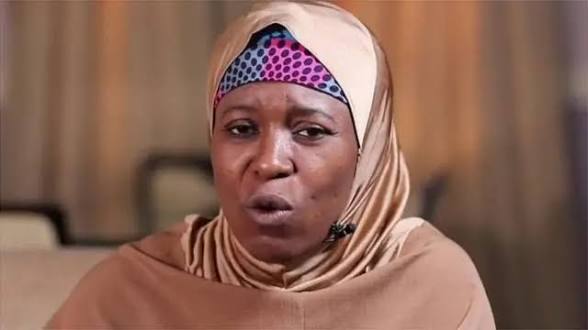
Former First Lady Aisha Buhari has given her most detailed account yet of events inside the Presidential Villa during the eight-year administration of her late husband, former President Muhammadu Buhari, alleging that unelected individuals hijacked power, restricted access to the President and operated covert surveillance within the Villa.
Aisha Buhari made the revelations in From Soldier to Statesman: The Legacy of Muhammadu Buhari, a book written by Dr. Charles Omole and recently presented at the Presidential Villa in Abuja.
According to her, individuals close to the President planted listening devices in private areas of the Villa, turning personal living spaces into informal intelligence centres. She alleged that confidential conversations were secretly recorded and relayed to a small group of power brokers who used the information to tighten their grip on access to Buhari.
She maintained that the surveillance was not part of authorised security operations but rather an informal system used for personal influence, which eroded trust within the First Family and isolated the President from alternative viewpoints.
Aisha Buhari described the situation as evidence of a presidency shaped not only by constitutional authority but also by unelected gatekeepers who controlled proximity to power.
She recalled that following Buhari’s election in 2015, the structure around him changed significantly. According to her, many women who campaigned alongside her were shut out of the Villa, while access to the President became increasingly restricted and transactional.
She said she became aware of her marginalisation after encountering a ministerial list outside Abuja, realising that her partnership with Buhari carried little institutional influence within the new power structure.
Rejecting claims that the notion of a “cabal” was speculative, Aisha Buhari described a network of elderly relatives and associates who feared that her assertive personality would weaken their influence. She revealed that she was advised to reach an “arrangement” with the group but declined, believing professionalism and mutual respect would prevail—an assumption she now considers misguided.
She further alleged that the shift in power dynamics affected her marriage, noting that Buhari was more receptive to criticism and open discussion before assuming office. Once in power, she said, he became increasingly insulated and dependent on a shrinking advisory circle.
On Buhari’s health, Aisha Buhari dismissed public speculation surrounding his prolonged medical absences, particularly his 154-day medical leave in London in 2017. She attributed his health challenges largely to disrupted routines and poor nutritional management after aides sidelined a dietary programme she said she had supervised for years.
She recalled convening senior officials, including Buhari’s physician and security chiefs, to outline a nutrition and wellness plan suitable for an ageing leader, but said the recommendations were ignored. She alleged that misinformation later led Buhari to stop taking prescribed supplements, resulting in noticeable weight loss and physical decline.
According to her, doctors in London eventually prescribed stronger nutritional supplements similar to those she had earlier recommended, after which Buhari’s condition improved.
She attributed his overall health challenges to age, environmental exposure during his military service, early-life smoking habits and respiratory sensitivities rather than any serious undisclosed illness.
Aisha Buhari said Buhari’s final illness was diagnosed as pneumonia, a condition that became critical due to age-related complications. She criticised the administration’s silence on his health, saying the lack of clear communication allowed rumours to flourish.
Reflecting on Buhari’s death in London at the age of 82, she described a swift transition from private grief to state protocol. She commended President Bola Tinubu for setting up a burial committee and ensuring that Buhari received full state honours.
She also praised Vice President Kashim Shettima and his wife for their support and acknowledged the role of Group Captain Abubakar Sadiq Adamu of the Presidential Air Fleet, who flew Buhari home after he left office and later transported his remains to Daura.
Aisha Buhari noted that individuals who once controlled access to the President lost their influence after his death. She insisted that neither she nor her children sought retribution but criticised the gatekeepers as lacking the capacity to manage the responsibilities of a presidency.
Her account, she said, was intended to shed light on how informal power structures can undermine governance. While it may not resolve debates about Buhari’s legacy, she argued that it raises a broader question about the extent to which elected leaders truly govern—or are governed by those around them.