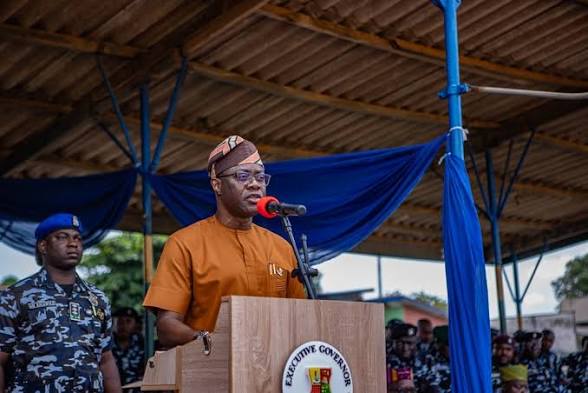
Governor Uba Sani of Kaduna State has declared that the state has witnessed significant improvement since he assumed office, noting that it is now more secure, stable and positioned for growth.
Sani said he inherited a state with enormous potential but weighed down by insecurity, infrastructure deficits and weak social indicators requiring urgent intervention.
The governor spoke at a workshop for senior government officials organised by the Nigerian Institute of Public Relations as part of the Nigeria Public Relations Week, Croc City 2026, held in Kaduna.
The workshop, themed “From Policy to Public Trust: Strategic Communication for Vision Alignment and Governance Delivery for Renewed Hope,” attracted commissioners, special advisers, counsellors, permanent secretaries and other top officials.
According to Sani, Kaduna has recorded measurable progress under his administration.
“Kaduna is no longer where it used to be. It is a better place today and on a steady path to achieving greater milestones,” he said.
He explained that his government adopted a results-driven approach anchored on Key Performance Indicators to ensure accountability across ministries, departments and agencies.
The governor said his administration’s blueprint revolves around seven pillars, including security, infrastructure, institutional strengthening, trade and investment, agriculture, human capital development and citizen engagement.
He described the pillars as interconnected strategies designed to drive inclusive growth and sustainable development.
On security, Sani emphasised that it remains the foundation for progress, adding that his administration collaborated with federal security agencies to establish military bases in volatile areas such as Giwa, Birnin Gwari and parts of Southern Kaduna.
He added that over 150 operational vehicles and 500 motorcycles were deployed to security agencies, while a joint task force was introduced in urban centres to curb crime.
The governor disclosed that more than 20,000 hectares of farmland previously abandoned due to insecurity had been recovered, while displaced residents were gradually returning to their communities.
He said over 1,000 displaced persons had been resettled, with continued support provided to more than 117,000 internally displaced persons, particularly women and children.
Sani also highlighted the establishment of a forensic laboratory, the Kaduna Incident Report Centre for emergency response, and the introduction of early warning systems to manage conflicts.
He said peace-building initiatives, including dialogue platforms and rehabilitation programmes, had contributed to improved stability across the state.
In the education sector, the governor said his administration constructed hundreds of classrooms, renovated existing ones and recruited thousands of teachers to improve learning outcomes.
He added that the number of out-of-school children had dropped significantly within two years due to targeted interventions.
To align education with economic needs, Sani said the state established a vocational training institute to equip youths with skills in technology and other emerging sectors.
On healthcare, he said several primary health centres had been upgraded, alongside the establishment of specialised centres and a major hospital to enhance service delivery.
The governor also listed ongoing road projects across the 23 local government areas, aimed at boosting connectivity and economic activities.
In agriculture, he said funding had been scaled up, with fertiliser distribution and insurance schemes introduced to support farmers, alongside agro-processing initiatives to promote value addition.
Sani further disclosed that Kaduna had attracted investments worth hundreds of millions of dollars, with additional projects in the pipeline, signalling growing investor confidence.
He added that his administration had expanded financial inclusion, supported vulnerable households and introduced a CNG-powered transport scheme to ease commuting costs.
The governor reaffirmed his commitment to equitable development, stating that initiatives such as Project 255 would ensure grassroots impact across all wards in the state.