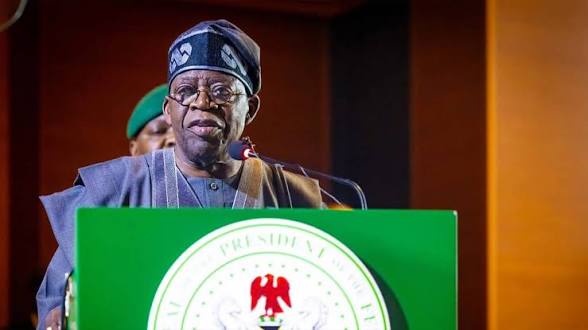
Contrary to the official explanation that former police chief Kayode Egbetokun resigned for family reasons, insiders at the presidency informed journalists that President Bola Tinubu requested his resignation for three primary reasons.
On February 24, Mr. Egbetokun stepped down as IGP at the behest of President Tinubu. The presidency confirmed this resignation and announced Olatunji Disu, an Assistant Inspector General (AIG), as the acting head of the police.
President Tinubu appointed Mr. Egbetokun as the 22nd IGP on June 19, 2023. His substantive appointment was later confirmed by the Nigeria Police Council on October 31 of the same year.
Mr. Egbetokun, who was 58 at the time of his appointment, was anticipated to retire upon reaching 60 years of age, per the Police Act. This law mandates that officers retire at 60 or after completing 35 years of service, whichever comes first.
Before he could reach either threshold, the National Assembly amended the Police Act to provide IGPs with a fixed four-year tenure, regardless of age or service length, unless they resign or are dismissed by the president.
This amendment effectively extended Mr. Egbetokun’s tenure, enabling him to serve a full four-year term set to conclude on October 31, 2027. The decision sparked criticism from various public segments who questioned its legality and timing. In response, the presidency maintained that his extended tenure was lawful, citing the amended police law.
Mr. Egbetokun departed from office at 61, just months after marking 35 years of service in 2025.
Reasons for Removal
Though the presidency stated Mr. Egbetokun resigned for family reasons, sources with first-hand knowledge of the situation reported that he was asked to step down for three key reasons.
One source indicated that the former police chief was removed due to his position on state policing, an initiative the presidency believes would enhance national security.
“He is not in support of the creation of state policing,” the source explained, noting that his position contradicted the government’s stance.
Another source affirmed this, stating Mr. Egbetokun “did not believe in the signatory policy of state police.”
President Tinubu has consistently championed the establishment of state police. During the National Dialogue on State Policing in April 2024, he declared his unwavering commitment to reforming the Nigeria Police Force and improving national security.
Represented by Vice President Kashim Shettima, Mr. Tinubu articulated that state policing is not merely a policy idea but could serve as a significant milestone in the evolution of the nation’s law enforcement, facilitating a more responsive approach to local needs.
In the same forum, Mr. Egbetokun voiced his opposition to the president’s perspective, arguing that Nigeria is not “mature” enough to implement state policing. He, as represented by Ben Okolo, expressed concerns that such a system could be misused by state officials.
“It is the submission of the leadership of the Nigeria Police Force that Nigeria is yet to mature and ready for the establishment of state-controlled police,” Mr. Egbetokun stated.
“There is the potential for abuse of power by the state political leadership,” he continued. “State governors could exploit police forces under their authority for political or personal gain, undermining human rights and security.”
Despite Mr. Egbetokun’s position, the president continued to advocate for the establishment of state police. Even shortly before Mr. Egbetokun’s removal, Mr. Tinubu reiterated during an interfaith breaking of fast event that his administration would create state police.
“What I promise you is not to be postponed,” Mr. Tinubu was quoted as saying at the event. “We will establish state police to combat insecurity.”
Another factor contributing to Mr. Egbetokun’s removal was a presidential directive concerning the withdrawal of police officers from VIPs.
At a security meeting in November 2025, President Tinubu specified that VIPs requiring security should seek well-armed personnel from the Nigeria Security and Civil Defence Corps (NSCDC).
Sources noted that the president was troubled by the poor compliance with this directive.
“The rate at which he has succeeded in withdrawing police officers from VIPs is quite low,” one source commented.
As for the third reason, a source familiar with the situation said Mr. Egbetokun was removed due to being blacklisted by the International Press Institute (IPI) Nigeria.
“The government felt embarrassed about the situation,” the source noted, adding that Mr. Egbetokun had previously been advised to address the issue by ensuring that attacks on journalists ceased under his leadership.
Amid growing concerns over journalist safety, the IPI Nigeria blacklisted Mr. Egbetokun, adding his name to the Book of Infamy.
Under his watch, approximately 24 journalists faced harassment by police officers, with many incidents going unpunished. Mr. Egbetokun’s silence regarding these issues further complicated matters.
These attacks included arbitrary arrests, summons, and detentions without legitimate justification. Despite recent legal amendments, the police reportedly continued to weaponize the Cybercrimes Act against journalists and dissenters under elite influence.
The IPI cited the lack of visible corrective action during Mr. Egbetokun’s leadership as a major reason for its decision.
Following Mr. Egbetokun’s departure, President Tinubu officially appointed Mr. Disu as the Acting Inspector General of Police on Wednesday.