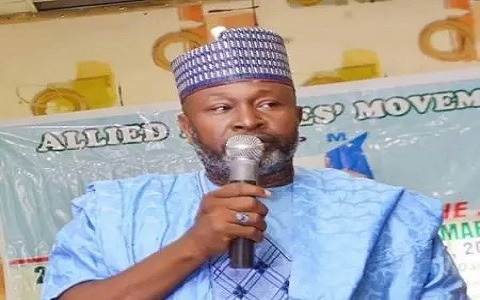
The National Chairman of the Allied Peoples Movement (APM) and Chairman of the Inter-Party Advisory Council (IPAC), Alhaji Yusuf Dantalle, has identified vote buying as one of the greatest threats to Nigeria’s democracy, warning voters against exchanging their future for immediate financial inducement.
Speaking on Monday during an interview on Frontline, a current affairs programme on Eagle 102.5 FM, Ilese Ijebu, Ogun State, Dantalle opened his submission with a strong caution to the electorate, urging them to reject electoral inducement at all levels.
“Elect who you want. Reject a peanut or that evil called vote buying,” he declared, adding a controversial but pragmatic note: “If they give you and you are forced to take, take, but do what is right.”
His remarks set the tone for a wide-ranging conversation that examined President Bola Ahmed Tinubu’s third year in office, Nigeria’s economic condition, and the structural challenges undermining governance and democracy.
Dantalle said he sympathised with the President, describing Tinubu’s reform agenda as well-intentioned but constrained by systemic inefficiencies and institutional weaknesses.
“I sympathise with the president. He is doing his best to fix Nigeria,” he said, while quickly adding that “Nigerians are suffering in a very terrible way today.”
The APM chairman noted that the removal of fuel subsidy was a necessary reform aimed at curbing corruption and redirecting public funds to development.
“When the president came on board, the first thing he did was to remove our oil subsidies,” he recalled. “The idea was to reinvest that money into infrastructure and other salient sectors of our socio-economic life.”
However, he argued that the expected benefits of the policy have not fully translated into improved living conditions for citizens.
“But unfortunately, that is not happening,” he said.
Responding to claims that government revenue has increased and borrowing reduced, Dantalle insisted that policy outcomes must be judged by citizens’ lived realities rather than fiscal reports alone.
“Is it reflective of the life of the people? You and I know that it’s not,” he said.
He compared governance to delegation within a household structure, stressing that leadership outcomes depend on execution at multiple levels of authority.
“I’ve sent people, I’ve delegated them, go do A, B, C… but what they have done, is it reflective of the life of the people? It’s not,” he said.
To further explain Nigeria’s social challenges, Dantalle drew from sociological theory, referencing Robert Merton’s strain theory to explain rising criminality.
“When you see growth in criminality, there is a remote cause,” he said, explaining that society produces different behavioural responses when systems fail.
He outlined categories such as conformity, innovation, ritualism, retreatism, and rebellion, linking “innovation” to crimes like cyber fraud and kidnapping.
“That innovation is what you see at Yahoo, you see at kidnapping, you see at so many social ills,” he said.
While acknowledging some infrastructural improvements under Tinubu’s administration, Dantalle said progress remains uneven and insufficient to reflect the scale of hardship.
“I commend the president and the Minister of Works. I see a lot of road infrastructure going on,” he noted. “But the average life of Nigerians… is beyond the reach of the common man.”
He added that the economic pressure is directly connected to worsening insecurity across the country.
“Because of this, insecurity is increasing,” he said.
When asked whether the APM would reverse key reforms such as subsidy removal and exchange rate unification if it assumed power, Dantalle rejected a simplistic policy reversal approach.
“The APM, my presidential candidate said we will reset Nigeria,” he explained.
According to him, “resetting Nigeria” goes beyond economic adjustments and requires a deep re-evaluation of national values, institutions, and governance culture.
“We have to look at the entire value system,” he said, listing issues such as corruption tolerance, inequality before the law, and moral decay.
He lamented that illicit wealth accumulation without legitimate means has become socially normalized.
“The system that you can make money without a conventional source of income,” he said, describing it as part of Nigeria’s structural dysfunction.
Dantalle also criticized what he described as unequal treatment in justice administration, where elites and ordinary citizens are not subjected to the same standards.
“The treatment that goes to the man who is a VIP and the man who is a common man is not the same,” he said.
He extended his critique to education and moral development, arguing that Nigeria’s social breakdown has contributed to rising insecurity, kidnapping, and destruction of public infrastructure.
“What kind of education do we have that killing ourselves has become a norm?” he asked.
He stressed the need to rebuild national identity and promote patriotism, warning against the growing aspiration among young Nigerians to leave the country at all costs.
“It has become a pride that you secure a visa to go abroad. It is an aberration,” he said.
Dantalle urged Nigerians to focus on domestic solutions rather than relying on foreign intervention.
“We must domesticate the solution to our problem,” he said, adding that national transformation depends on political and economic nationalism.
He called for inclusive governance and an end to winner-takes-all politics, suggesting that electoral losers should be integrated into governance conversations.
“We must learn to avoid politics of winner takes all and loser lose all,” he said.
CALLR’S REACTION
During the interactive session, callers weighed in on insecurity, governance failure, and political accountability.
One caller praised Dantalle’s remarks and called for opposition parties to unite in rescuing Nigeria from worsening insecurity, citing reports of increased attacks on security personnel.
Another caller from Ijebu Ode raised concerns about accountability in governance and referenced allegations surrounding political figures and financial management.
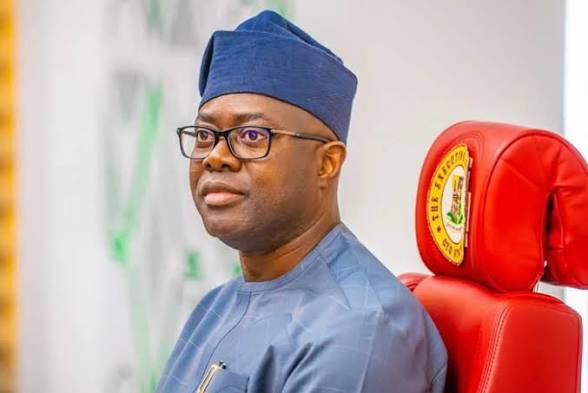
In response to the caller’s reaction, Dantalle reiterated his confidence in APM’s presidential candidate, Oyo State Governor Seyi Makinde, describing him as a practical and people-focused leader.
“If anybody will be sincere, you know the situation of Oyo State before his emergence,” he said.
He argued that Makinde has demonstrated measurable progress in infrastructure and governance in Oyo State.
“If you juxtapose pre-Seyi Makinde and Seyi Makinde’s tenure, you will know if he is capable of replicating the same thing across board,” he said.
Dantalle described the governor as youthful, passionate, and committed to inclusive development.
“He is people-oriented. Whatever he does is about the people,” he said.
He added that Makinde himself prioritizes public interest over personal ambition.
“He told me personally that it is not about him as Seyi Makinde,” Dantalle revealed. “It is about the people.”
The APM chairman said the party’s ideology is rooted in egalitarian principles and national prioritization.
“It is the motto of our party: APM is Nigeria first. We are egalitarian in nature,” he stated.
He concluded by linking Nigeria’s insecurity and socio-economic challenges to systemic neglect and exclusion.
“What you are seeing today is insecurity. It is a product of neglect. It is a product of exclusion,” he said.
Dantalle insisted that Nigeria’s future depends on restoring ownership of the country to its citizens through a collective value reset.
“If Nigerians are made to believe they own Nigeria, nobody would want to destroy what belongs to him,” he said.
He maintained that the APM and its allies are committed to what he described as a “national reset agenda” aimed at rebuilding institutions, restoring trust, and strengthening democratic participation ahead of future elections.