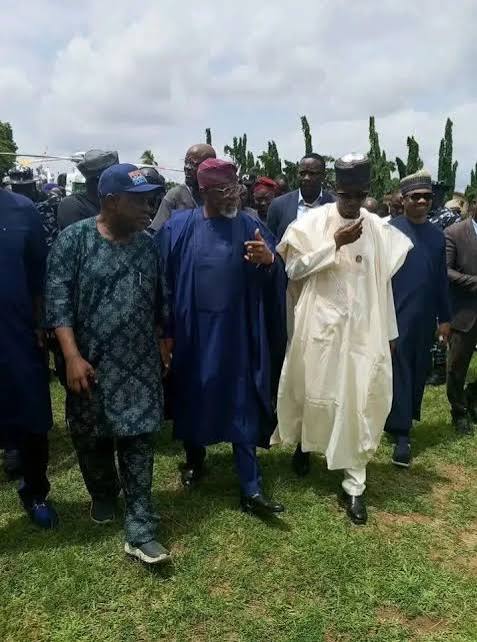
Former Attorney-General of the Federation (AGF) and Minister of Justice, Abubakar Malami, spent a second consecutive night in Economic and Financial Crimes Commission (EFCC) custody on Tuesday after failing to meet bail conditions during an intensified investigation into alleged financial misconducts spanning his tenure under the Muhammadu Buhari administration.
Sources revealed that Malami, who arrived late for questioning on Monday evening, has been reporting daily to the EFCC headquarters, where interrogators are scrutinizing no fewer than 46 bank accounts allegedly linked to him, each reportedly holding billions of naira and millions in foreign currency, forming a central pillar of the ongoing inquiry.
The probe encompasses 18 alleged offenses, including money laundering, abuse of office, and terrorism financing, with Malami unable to fully account for key recoveries such as $346.2 million in Abacha loot from Switzerland, funds from the Island of Jersey, and the disbursement of N4 billion from the Central Bank of Nigeria’s Anchor Borrowers’ Programme.
Investigators are revisiting at least five high-profile suspicious transactions from Malami’s time in office, starting with the controversial $496 million payment to Global Steel Holdings Ltd (GSHL) as compensation for terminating the Ajaokuta Steel concession—nine years after the Indian firm had waived all claims.
Another focal point is Malami’s oversight of the sale of multi-billion-naira assets forfeited to the EFCC by politically exposed persons, which sources describe as shrouded in opacity and conflicting valuations. The EFCC is also probing his role in approving a $419 million judgment debt to consultants claiming credit for facilitating Paris Club refunds to Nigerian states, alongside the $200 million compensation to Sunrise Power in the disputed Mambilla power project contract.
Additional lines of inquiry include the alleged duplication of legal fees in repatriating $321 million of Abacha loot from Switzerland to Nigeria, where Malami’s investments—estimated at N10 billion in schools, hotels, and rice mills in his home state of Kebbi—have come under sharp focus.
EFCC spokesperson Dele Oyewale declined to comment when contacted, maintaining the agency’s standard protocol on active investigations.
Malami, who faced an initial interrogation on November 29, described that session as “successful” in a post on X, noting he had been scheduled for “further engagement” while dismissing the allegations as fabricated.
In a detailed statement issued by his media aide, Mohammed Doka, Malami refuted EFCC claims of duplicating the $310 million (later $322.5 million with interest) Abacha loot recovery process, calling them “baseless, illogical, and devoid of substance” that “collapse under factual scrutiny.”
He clarified that no prior recovery by Swiss lawyer Enrico Monfrini had been finalized before his 2015 appointment, as funds were not lodged into the Federation Account by 2016, and Monfrini himself sought re-engagement in December 2016—evidence Malami argues contradicts the EFCC’s narrative. An associate of the former AGF emphasized that Malami remains cooperative, reporting daily as required.