The Federal Government signals that restarting oil exploration in the region could mark a turning point for Nigeria’s socio-economic fortunes.
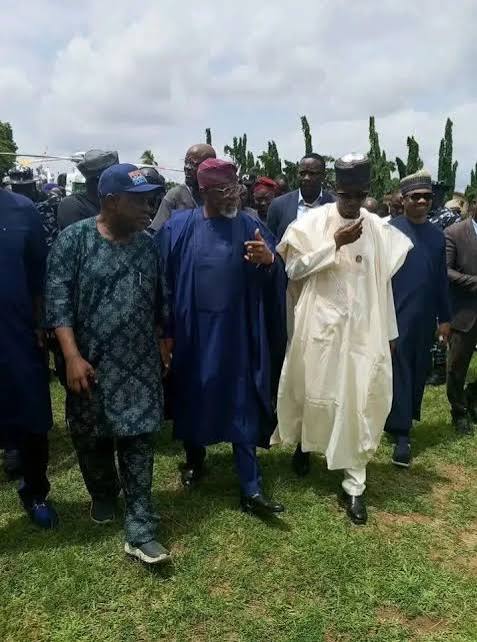
National Security Adviser Maj. Gen. Nuhu Ribadu (retd.) made the remarks Monday while leading a high-level presidential delegation, including the Ministers of Works and Environment, on a courtesy visit to Rivers State Governor Siminalayi Fubara at Government House, Port Harcourt. The visit underscored the federal government’s growing confidence that Ogoni, long embroiled in conflict over oil exploitation, could become a catalyst for national progress.
“We are here as a delegation of President Bola Ahmed Tinubu,” Ribadu said, acknowledging the cooperation between federal and state authorities as well as Ogoni leaders. “We have worked as one…particularly, we are here because of the Ogoni part of Nigeria. And we did an incredibly good job together as one.”
Ribadu described the Ogoni people and their leaders as “quality human beings,” noting their crucial role in opening dialogue with the federal government after more than three decades of stagnation in oil production caused by historic crises.
“Ogoniland is looking like the turning point for Nigeria today,” he said. “A new chapter is being opened. Nigeria will not be what it used to be again. Things are changing, and it is starting with Ogoni.”
Ribadu also conveyed President Tinubu’s gratitude to both Governor Fubara and Ogoni stakeholders for their cooperation and contributions toward what he described as an “amazing programme of three decades” now poised to unlock significant opportunity for the country.
For his part, Works Minister Senator Dave Umahi lauded the Ogoni peace initiative as a cornerstone of Nigeria’s renewed unity and reiterated the President’s personal commitment to Niger Delta development.
Umahi outlined plans to complete the East-West Road, particularly the Eleme axis — a ₦200 billion project with five flyovers — by April 2026. He added that with presidential backing, the Bonny–Bodo Road is also set for dualisation, complete with two new flyovers.
In a broader regional initiative, the Minister revealed that President Tinubu has ordered a redesign of the Lagos–Calabar Coastal Highway to include a route through Ogoniland, reinforcing the federal government’s strategy to integrate the area more fully into national economic networks.
Environment Minister Balarabe Lawal confirmed that the ongoing Ogoni clean-up project remains a top priority for his ministry. He emphasized progress on various United Nations Environment Programme (UNEP)-recommended efforts, such as mangrove restoration, healthcare delivery, human capital development, and women’s empowerment.
Representatives of the Nigerian National Petroleum Company Ltd. (NNPCL) also stressed a shift toward people-centric engagement. According to NNPCL’s Bayo Ojulare, the company is committed to the dialogue process, with plans to employ 30 Ogoni indigenes and issue resumption letters slated for January 2026. Ojulare described current developments as “a model for a new Nigeria.”
Governor Fubara expressed profound gratitude to President Tinubu for intervening in the decades-long Ogoni crisis. He highlighted the progress on critical roads linking Bonny and Bayelsa and stressed that the administration’s efforts go beyond infrastructure to rebuilding trust and confidence in the region.
“I want to say first, thank you to Mr. President … resolving a crisis that lingered for over three decades in Ogoniland was not an easy task,” the governor said. “We are beginning to see the result.”
Fubara added that improved connectivity via the East-West Road is already making travel easier for residents and underscored his commitment to sustaining peace and supporting ongoing development efforts.